Cycling In Piedmont Italy: Roads, Gradients And Surfaces
Piedmont's wine hills are rolling in the postcard villages and mountainous behind them. This is the riding-conditions page: what the gradients really cost, what the roads are made of, and what the law expects of you.
 By Chiara Barbero, Piedmont Bike Tour Guide and Langhe Cycling Specialist
Short answer
Cycling in Piedmont means quiet farm roads between wine villages that all sit within about 20 km of Alba. The Barolo loop climbs roughly 877 m over 67.9 km, the Alta Langa tops 1,040 m of ascent, and the Tanaro valley to Asti is effectively flat. September averages a 23.6 °C high.
Barolo village has 613 residents. Alba, the town at the centre of the region, has 30,985. Between them runs about 14 km of farm road through the heart of the Piedmont Bike Tours territory, and that contrast, a world-famous wine name attached to a village of barely six hundred people, is what defines riding here: the distances are short, the roads are narrow, and the hills are steeper than the postcards admit.
This page is the riding-conditions reference. It covers the terrain with real height-gained figures rather than invented gradients, the road surfaces, the distances between the villages, the Italian cycling law that actually applies, and the seasons. It does not pretend a bike path exists where one is still on paper.
What Is Cycling In Piedmont Italy Actually Like?
Cycling in Piedmont is short-distance, quiet-road riding through terraced vineyard hills, where every famous wine village sits inside about 20 km of Alba and the climbing is real but concentrated: roughly 877 m of ascent on the full Barolo villages loop, about 457 m on the Barbaresco loop, and effectively none along the Tanaro valley to Asti. It suits road bikes, e-bikes and confident riders, not beginners on flat-bar hybrids expecting a rail trail.
The single most useful geographic fact about the region is that it is compact. Alba to Barolo is about 13.9 km by road. Alba to La Morra is about 15.8 km, to Serralunga d'Alba about 15.5 km, to Monforte d'Alba about 19.6 km. A rider based in Alba can reach every major Barolo and Barbaresco village on a morning loop and be back for lunch, which is why nearly all the touring here is loop-based rather than point-to-point.
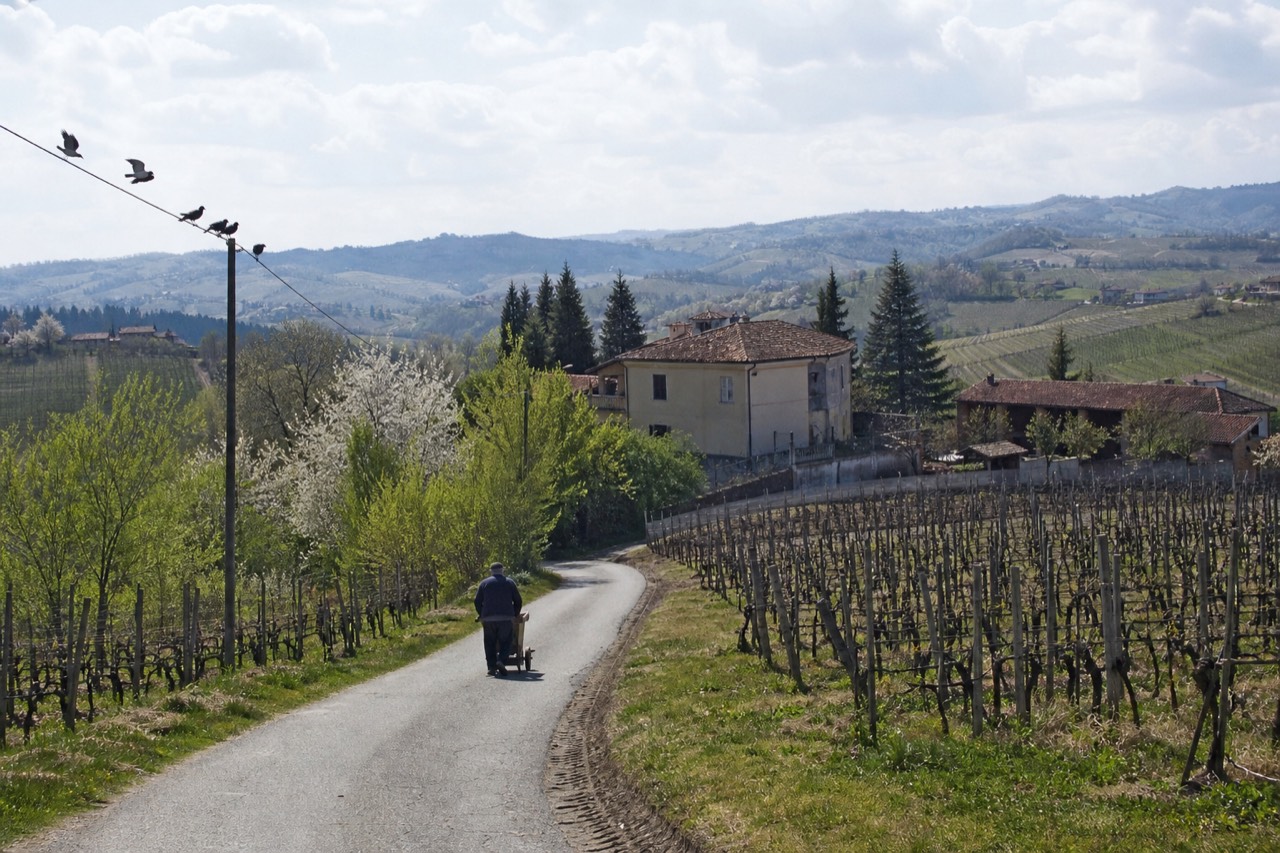
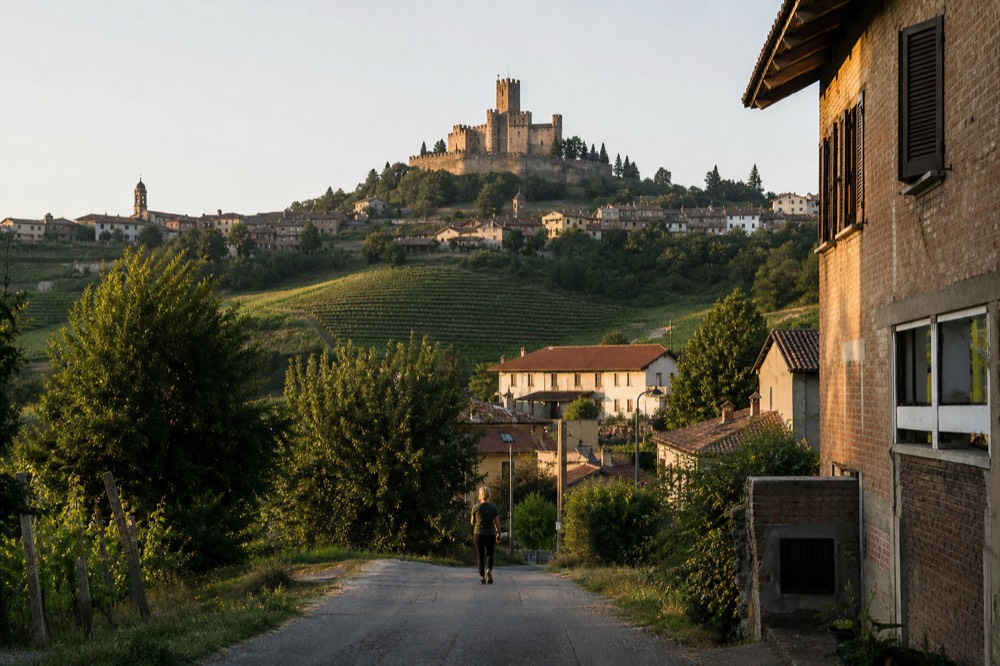
The second fact is that the region is quieter than the wine's fame suggests. These are farm roads first: narrow, sometimes single-lane, used by tractors during the harvest and by almost nobody in between. Traffic is lightest midweek and outside the truffle-fair weekends of October and November, when Alba fills up with visitors and the village approach roads fill with cars.
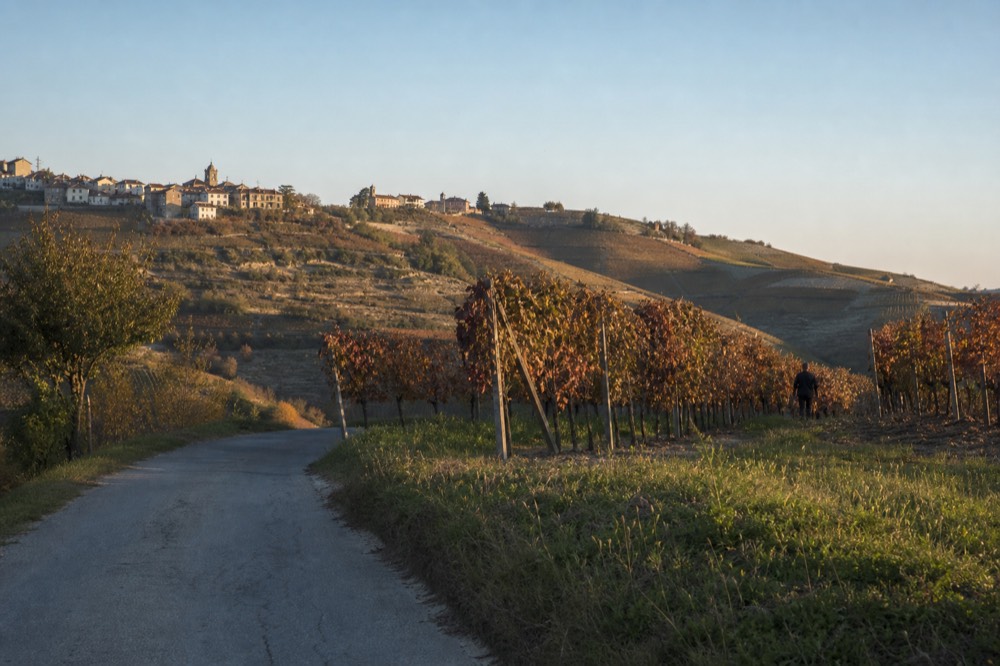
The third fact is the one international operators rarely publish: the working elevation band is wide. Alba sits at 179 m and its lowest ground, on the Tanaro, is 139 m. Mombarcaro, in the Alta Langa, tops out at 896 m, the highest point of the surveyed comuni, locally called the vetta delle Langhe. The wine villages occupy the gentle middle of that range, and the Alta Langa behind them is genuinely mountainous.
How Much Climbing Is There, Really?
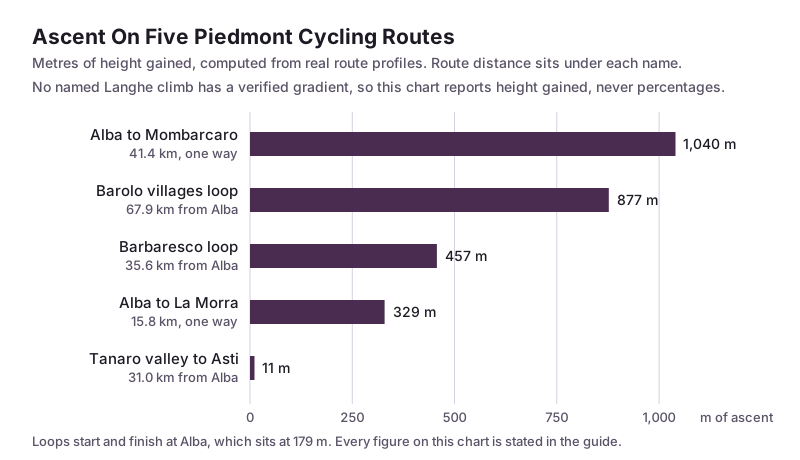
The honest numbers, computed from real route profiles, are these: the full Barolo villages loop from Alba covers 67.9 km with roughly 877 m of climbing, topping out at 521 m; the Barbaresco loop covers 35.6 km with about 457 m of ascent; the Alba to Mombarcaro climb covers 41.4 km and gains about 1,040 m; and the Tanaro valley run from Alba to Asti registers almost no climbing at all.
No named climb in the Langhe has a published, verified gradient. Rather than invent percentages, this site works from height gained, which is both defensible and more useful for planning. A rider climbing to La Morra from the valley gains roughly 320 to 370 m of height: the village centre stands at 508 m above a valley floor at 139 to 186 m, and the computed Alba to La Morra profile agrees at 329 m of ascent over 15.8 km. That is a solid half-hour climb, not a bump.
| Route | Distance | Ascent | Low | High |
|---|---|---|---|---|
| Barolo villages loop from Alba | 67.9 km | ~877 m | 167 m | 521 m |
| Barbaresco loop from Alba | 35.6 km | ~457 m | 149 m | 410 m |
| Alba to Mombarcaro, one way | 41.4 km | ~1,040 m | 174 m | 858 m |
| Alba to La Morra, one way | 15.8 km | ~329 m | 167 m | 498 m |
| Alba to Barolo, one way | 13.9 km | ~120 m | 167 m | 288 m |
| Alba to Asti along the Tanaro | 31.0 km | ~11 m | 116 m | 174 m |
These are computed figures, derived from routed road geometry and elevation data, not an operator's route card, so treat them as "roughly" in your own planning. The shape of the table is the message. The wine-village loops are rolling: repeated 100 to 350 m climbs, none long enough to demand training-camp fitness. The Alta Langa is different country, a thousand metres of ascent to reach the high villages, and it should be planned as its own day. The Tanaro corridor to Asti is the flat escape valve, and it is genuinely flat: both towns sit near the river, Alba's centre at 179 m and Asti's at 131 m.
For riders who want the hills with a motor in reserve, a private e-bike tour of the Langhe del Barolo handles the routing and the climbing in one booking, and the guide knows which back roads avoid the busier stretches. See the Langhe del Barolo private e-bike tour for the format, or Check availability if the dates are already firm.
The alternative for self-planners is to break the Barolo loop into halves: Alba to La Morra and Barolo one day, Monforte, Serralunga and Castiglione Falletto the next. The villages are close enough that a shorter day still visits three or four of them, and every one has a bar or a cellar where a mid-ride stop is normal.
What Are The Road Surfaces Like?
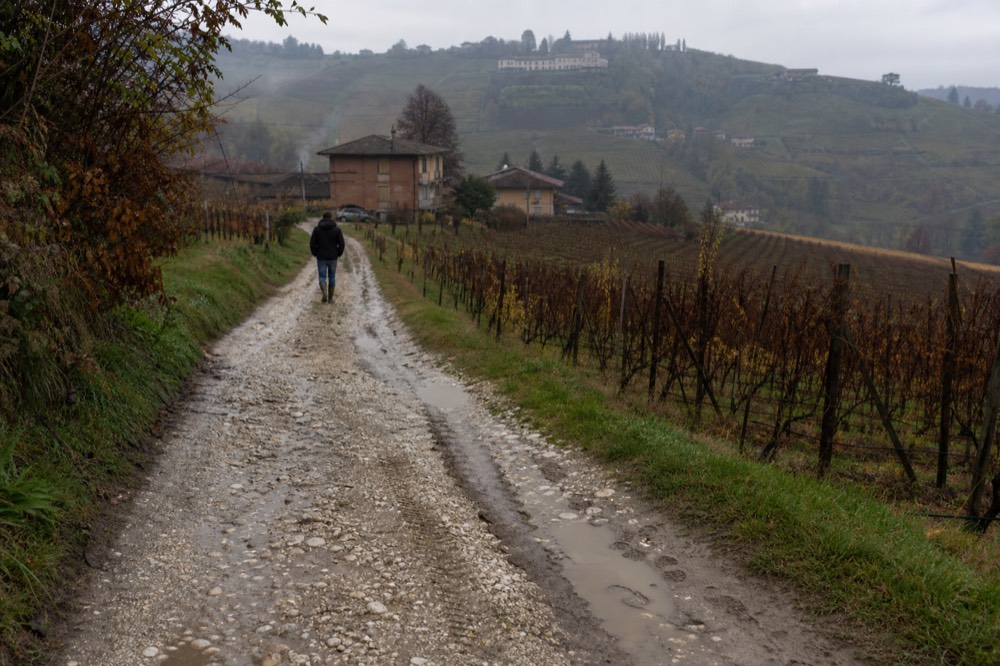
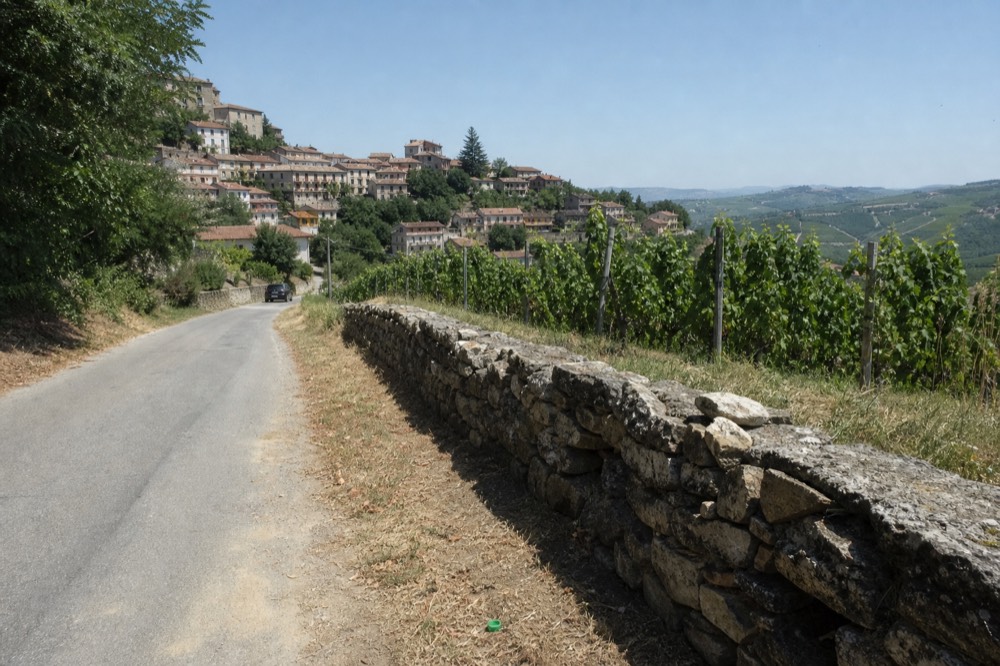
The roads are mostly asphalt, and mostly narrow: single-carriageway farm roads through vineyards, well maintained on the wine-village links, rougher with patches and occasional gravel wash on the higher Alta Langa roads, plus a genuine network of unpaved strade bianche between the vine rows that is rideable on wider tyres but unverified as a named route network with real distances.
Asphalt quality on the main village links, Alba to Barolo, La Morra to Barolo, the Serralunga road, is good. These are working roads for the wine trade, kept in condition for tractors, trucks and cellar traffic. The surface deteriorates with altitude: above 600 m in the Alta Langa, patched asphalt, broken edges and short gravel sections become normal, and after the summer storms of 2026, which included a supercell that dropped 80 mm of rain and hail on the Langhe vineyards in early August, washout debris on secondary roads is a real possibility through autumn.
The unpaved roads are a genuine feature. The vineyard rows are linked by strade bianche, white gravel roads, and the Langhe's UNESCO-inscribed landscape is threaded with them. But no named gravel route in the Langhe has verified distance or ascent figures, so this site does not publish any. If you want to ride them, do it on wide tyres, with the same caution you would apply to any farm track, and expect tractor ruts after rain.
One infrastructure fact matters here because it is often misreported. A 32.5 km cycle route between Alba and Canelli, the Ciclovia delle Colline Unesco, is funded with a €10 million regional grant, and works were due to be assigned by September 2026. It is not built. No rider can ride it today, and any itinerary that claims otherwise is wrong. The Comune di Alba's own announcement is the primary source for its status.
Which Routes Should You Actually Ride?
Three routes cover the region honestly: the 67.9 km Barolo villages loop from Alba through Grinzane Cavour, La Morra, Barolo, Novello, Monforte d'Alba, Serralunga d'Alba and Castiglione Falletto; the 35.6 km Barbaresco loop through Barbaresco, Neive and Treiso; and the flat 31 km Tanaro valley run from Alba to Asti for recovery days.
The Barolo loop is the flagship. It links all three comuni that sit entirely inside the Barolo DOCG zone, Barolo, Castiglione Falletto and Serralunga d'Alba, plus La Morra and Monforte, and it can be joined or shortened at almost any village. The Barbaresco loop is its gentler sibling, about half the climbing, and it passes through Neive, one of the region's prettiest villages. The Tanaro run to Asti is the flat option, and Asti itself, with 73,604 residents the biggest town in the area, is a real city at the end of it.
| Village | Elevation (centre) | Distance from Alba | Why stop |
|---|---|---|---|
| Grinzane Cavour | 201 m | ~7.5 km | Castle, Barolo-zone gateway |
| Barolo | 303 m | ~13.9 km | WiMu wine museum, the name village |
| La Morra | 508 m | ~15.8 km | Highest of the wine villages, viewpoint |
| Serralunga d'Alba | 390 m | ~15.5 km | Iconic medieval castle |
| Monforte d'Alba | 472 m | ~19.6 km | Amphitheatre piazza, cellar scene |
| Neive | 294 m | ~13.4 km | Barbaresco zone, village charm |
| Barbaresco | 262 m | ~13.5 km | Tower over the Tanaro |
| Castiglione Falletto | 349 m | on the loop | Serralle castle, quiet centre |
For riders who want the villages without self-navigation, the picnic-format e-bike tour through the Barolo vineyards is the mid-price option in the region, from $93 per person for about six hours, and it covers the same core villages with a guide. The Barolo vineyards picnic e-bike tour page has the detail.
Route planning in detail, village by village, is covered in the dedicated Barolo bike tour routes guide, and the quieter half of the region, the Roero and Monferrato across the Tanaro and east of Asti, has its own treatment in cycling Monferrato and Roero.
What Are The Cycling Rules In Italy?
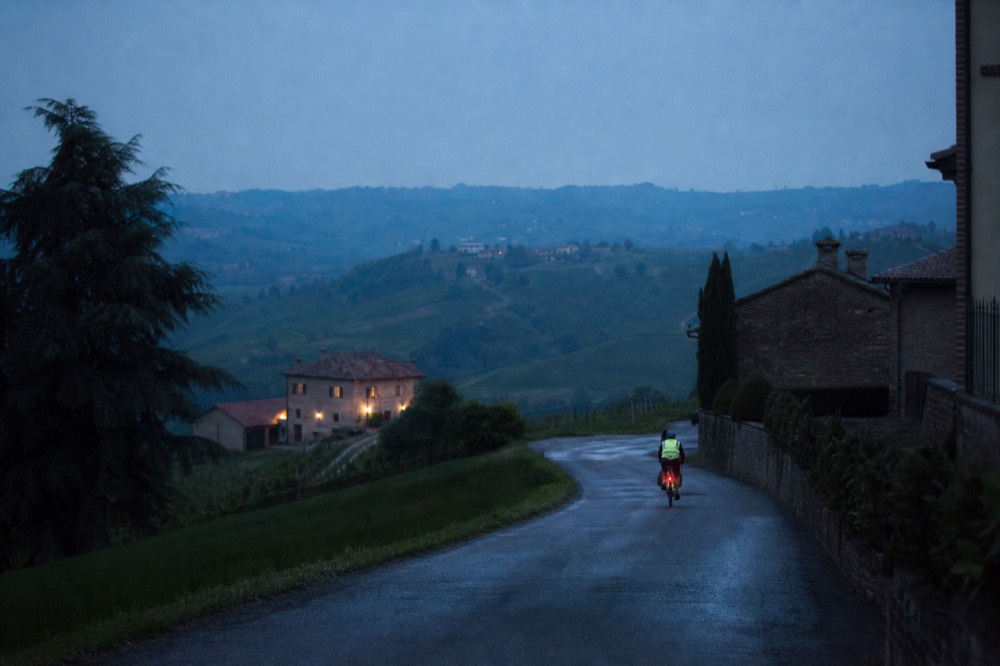
Italy has no helmet law for cyclists of any age, but it does require a high-visibility reflective vest outside built-up areas from half an hour after sunset to half an hour before sunrise, and in tunnels at any hour; a bell is legally required equipment, riders outside built-up areas must ride single file, and motor vehicles must give at least 1.5 m of passing distance where road conditions permit.
These rules come from the Codice della Strada itself, and they matter more here than in most Italian regions because the Langhe is almost entirely outside built-up areas. An autumn ride finishing near dusk crosses the vest threshold easily, and the tunnel rule carries no time condition: it applies in daylight too.
The equipment list is short but specific. A bicycle must have working brakes on both axles, a bell, white or yellow front lights, red rear lights and reflectors, plus pedal and side reflectors. The fine for missing equipment, or for breaching the riding rules, runs €26 to €102. Riding two abreast is permitted inside towns where traffic allows, but never more than two, and never outside built-up areas, with one exception: a child under ten may ride to the right of an adult.
| Rule | What the law says | Where it bites in Piedmont |
|---|---|---|
| Helmet | No legal requirement at any age | Recommended, not required |
| Reflective vest | Mandatory outside built-up areas after dusk, and in tunnels at any hour | Almost every Langhe road is outside built-up areas |
| Bell | Required equipment | Most rental road bikes lack one |
| Formation | Single file outside built-up areas | Group rides on farm roads |
| Passing distance | Vehicles must give 1.5 m where road conditions permit | On narrow vineyard roads expect patience |
| E-bikes | 250 W, 25 km/h assist, motor cuts when pedalling stops | Standard pedelecs are bicycles in law |
The e-bike point is worth spelling out. A compliant pedelec, 250 W nominal, assistance cutting out at 25 km/h and when you stop pedalling, is legally a bicycle in Italy: no licence, no plate, no insurance. A speed pedelec that exceeds those limits is treated as a moped, with everything that follows. The current law is published in article 182 of the Codice della Strada on the ACI's official text.
Can You Take A Bike On The Train?
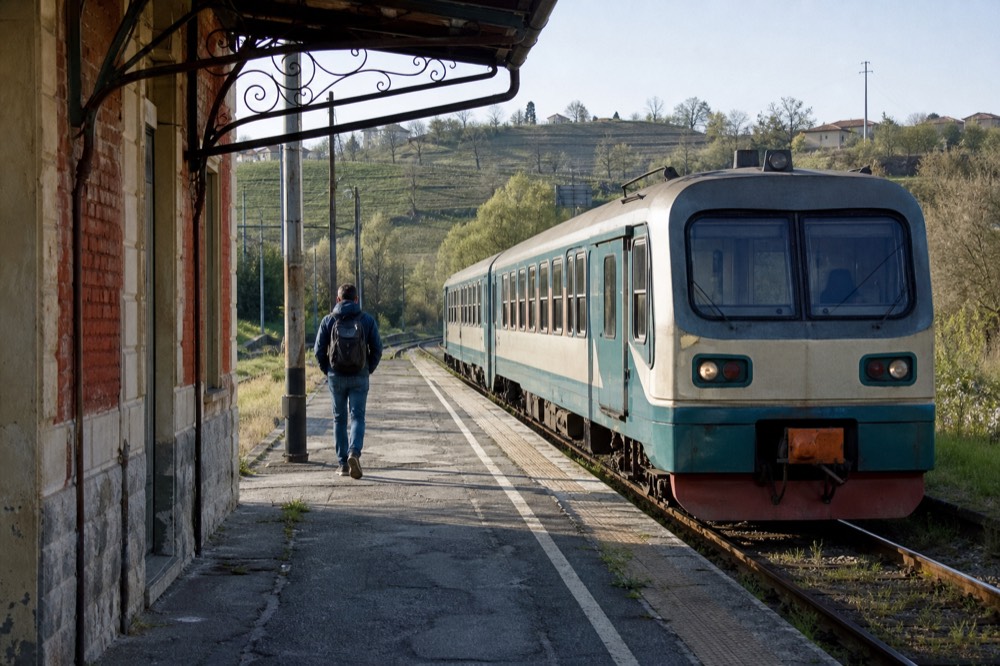
Yes, on Trenitalia Regionale trains marked with the bike pictogram, an assembled bike costs a €3.50 supplement valid until 23:59 of the day shown on the ticket, e-bikes are explicitly included, and a folded folding bike travels free on all Regionale services; the practical gateways are direct trains from Turin to Alba in a little over an hour and a half, and a change is required coming from Milan.
The bike supplement is the cheapest piece of cycling infrastructure in the region and it is published on Trenitalia's own Regionale page. The alternative to the supplement is simply buying a second second-class ticket for the bike. Note the pictogram condition: only Regionale trains marked for bikes accept them, and the high-speed services do not.
The rail geography matters for planning. Turin to Alba is direct, no change, on the Torino-Bra-Alba line, with journey times reported between 1 h 20 and 1 h 33 depending on the service, so a Turin-based rider can be in the Langhe for a day loop without a car. Milan to Alba requires a change, typically at Torino Porta Susa. The Alba-Asti line reopened in September 2023, which makes the flat Tanaro ride a one-way option: ride to Asti, train back. The Alba-Alessandria line remains suspended, and there is no train on it.
For riders who would rather not transport a bike at all, rental exists in Alba and around the Barolo zone, and the e-bike rental with food and wine experiences in the Langa del Barolo, from $52 per person for a full day, is the budget entry point to the region. The Langa del Barolo e-bike rental page lists what is included.
When Is The Best Time To Ride?
The best months are May, June and September: September is the standout, with an average high of 23.6 °C at Alba and the harvest in progress; July and August are the hardest months for heat, with average highs of 29.2 °C and 28.8 °C; and November through February are the wettest and coldest, with November averaging 115 mm of rain and January highs of 7.2 °C.
These figures are computed from the ERA5 reanalysis over the 1991-2020 period at Alba's coordinates, so treat them as typical conditions rather than an official weather-station record. The shape is reliable: July is the driest month at 37 mm, November the wettest at 115 mm, and the annual total is about 856 mm.
| Month | Avg high | Avg low | Avg rain |
|---|---|---|---|
| March | 13.9 °C | 3.8 °C | 66 mm |
| April | 17.3 °C | 7.5 °C | 89 mm |
| May | 21.5 °C | 12.0 °C | 88 mm |
| June | 26.1 °C | 16.0 °C | 67 mm |
| July | 29.2 °C | 18.7 °C | 37 mm |
| August | 28.8 °C | 18.9 °C | 49 mm |
| September | 23.6 °C | 14.7 °C | 81 mm |
| October | 17.6 °C | 10.4 °C | 90 mm |
| November | 11.7 °C | 5.1 °C | 115 mm |
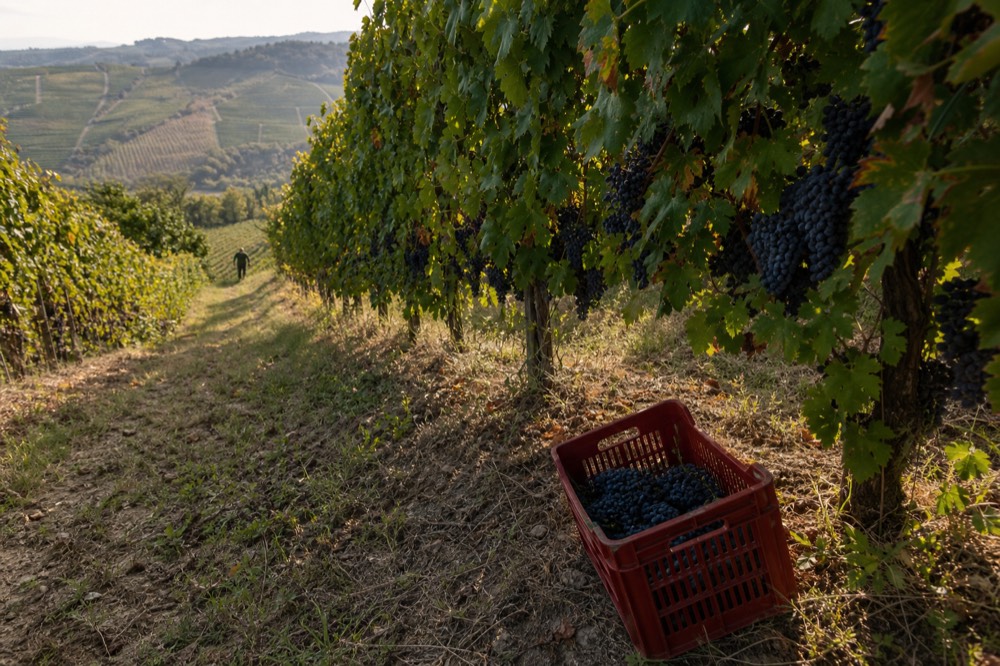
September pairs the best riding temperatures with the vendemmia. The pattern, which shifts a week or two each year, runs like this: early varieties and sparkling bases from mid-August, Dolcetto and Barbera in early September, Nebbiolo from late September, with Barolo fruit usually the last off the hill in early October. A September rider shares the roads with tractors and grape trailers, which is a fair trade for the atmosphere.
October adds the truffle season. The Fiera Internazionale del Tartufo Bianco d'Alba runs from 10 October to 6 December 2026, with the world truffle market open Saturdays and Sundays only, and those weekends are the busiest of the year in Alba. If you want the fair without the crowds, ride on the weekdays and visit Alba on a weekday evening. The full seasonal picture, including harvest and foliage timing, is in the best time to visit Piedmont guide.
Do You Need An E-Bike For The Langhe?
No, but it changes what a day looks like: a fit rider on a road bike can complete the 67.9 km Barolo loop with roughly 877 m of climbing in a long morning, while an e-bike flattens the repeated 300 m climbs, extends the range to the Alta Langa, and is the difference between one village loop and three for untrained riders, since Italian law treats a compliant 250 W, 25 km/h pedelec exactly as a bicycle.
The honest framing is fitness-dependent. The Barolo loop is a moderate road ride, not a sportive. The Barbaresco loop is genuinely easy. The Mombarcaro run is a proper mountain day, 1,040 m of ascent, and it is where pedal assist earns its keep even for strong riders, because the descent home is long and the climbs back up the side valleys are relentless.
The e-bike case for this region specifically, why the Langhe suits pedal assist more than most wine regions, is argued in full in the e-bike tours in Italy guide. The short version: short climbs, frequent stops, cellar visits that reward arriving without needing a shower, and a legal framework that puts pedelecs on equal footing with ordinary bicycles.
What Should You Plan Before You Go?
Plan four things in advance: where you base yourself, Alba is the practical hub with every wine village within 20 km; how you arrive, Turin Caselle airport is about 90 km away with a direct train alternative from Turin; what you ride, rental exists in Alba and the Barolo zone but book ahead in September and October; and the vest, bell and lights the law requires, which most visiting road cyclists do not carry.
Basing decisions are covered in where to stay in Piedmont, and the arrival logistics, airports, trains and driving times, in how to get to Alba. The one planning item riders most often miss is equipment legality: the bell. It is required, it is cheap, and rental bikes in Italy normally have one, while bikes brought from abroad often do not.
If a guided day is the right format, the three options below span the private, picnic and self-guided-rental approaches to the same hills.
Cycling in Piedmont comes down to a handful of practical questions: whether the hills suit a beginner, what the law requires you to wear and carry, how steep the climbs really are, whether the famous villages link up by bike, and whether you can bring a bike on the train. The answers below cover each one with the same verified figures used throughout this guide.
Common Questions About Cycling In Piedmont Italy
Is cycling in Piedmont Italy suitable for beginners?
The Barbaresco loop, about 35.6 km with roughly 457 m of climbing, and the flat Tanaro valley run from Alba to Asti are beginner-friendly. The full Barolo loop and the Alta Langa are not. An e-bike widens what a beginner can ride considerably, and compliant pedelecs are legally bicycles in Italy.
Do you have to wear a helmet cycling in Italy?
No. Italy has no helmet law for cyclists of any age. A reflective vest is mandatory outside built-up areas from half an hour after sunset to half an hour before sunrise, and in tunnels at any hour, and a bell is required equipment. A helmet is still a sensible choice on fast descents.
How steep are the Langhe hills?
No named climb in the Langhe has a verified published gradient. Measured by height gained: the climb to La Morra gains roughly 320 to 370 m, the full Barolo villages loop totals about 877 m of ascent, and the run up to Mombarcaro gains about 1,040 m over 41.4 km.
Can you cycle from Alba to Barolo?
Yes, in about 13.9 km by road with roughly 120 m of ascent on the direct route. Most riders make it a loop via La Morra, Diano d'Alba or Serralunga d'Alba instead, since every major wine village sits within about 20 km of Alba.
Are there bike paths in the Langhe?
No dedicated long-distance bike path is rideable today. The 32.5 km Ciclovia delle Colline Unesco between Alba and Canelli is funded but not built, with works due to be assigned by September 2026. Riding here is on quiet farm roads, which is a different and arguably better experience.
Can you take an e-bike on Italian trains?
Yes. E-bikes are explicitly included in the Trenitalia Regionale bike rules, alongside ordinary bicycles, for the €3.50 supplement valid until 23:59 of the ticket date, on trains marked with the bike pictogram. A folded folding bike travels free.